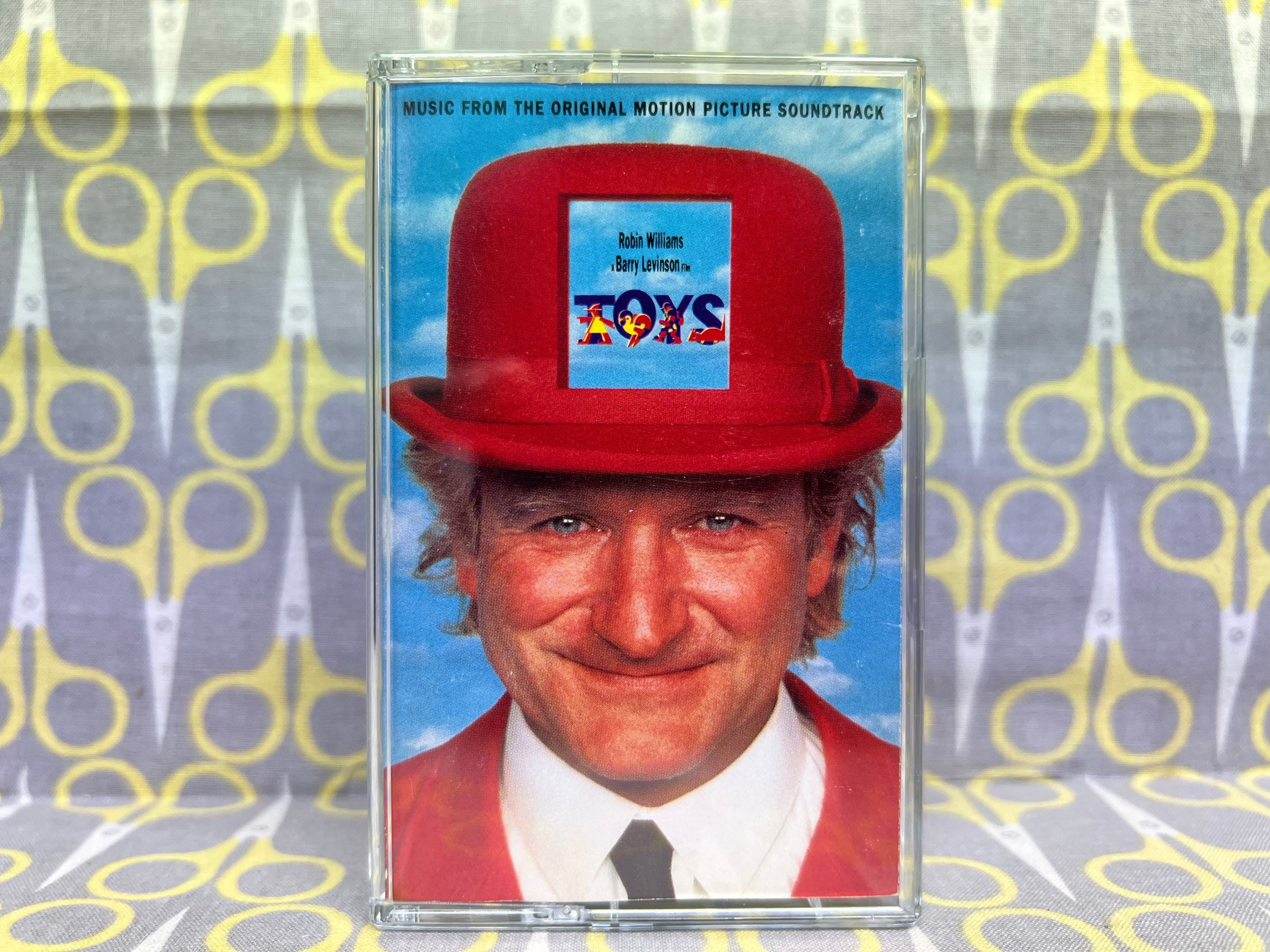
When Barry Levinson released “Toys” in 1992, audiences saw an eccentric comedy wrapped in bright colors and surreal humor. Decades later, many viewers are revisiting the film and discovering that its vision of technology-driven warfare now feels remarkably close to reality.
For years, “Toys” existed as one of Hollywood’s strangest commercial disappointments. Directed by Barry Levinson and starring Robin Williams, Joan Cusack, LL Cool J and Michael Gambon, the film arrived during the competitive holiday movie season of the early 1990s with high expectations and major studio backing. Yet despite its recognizable cast, ambitious production design and imaginative visual style, the movie struggled critically and commercially after release.
Over time, the film faded from mainstream discussion and became increasingly difficult to find on modern streaming platforms. Unlike many cult classics that enjoy steady rediscovery through television reruns or digital services, “Toys” nearly disappeared from public conversation for years. However, the rise of online clips and social media discussions has unexpectedly brought renewed attention to the film, especially as global warfare increasingly incorporates drones, remote operations and gamified military technology.
Many viewers now feel the film foreshadowed elements of contemporary warfare long before they dominated daily news, turning what seemed far-fetched or overstated in 1992 into something eerily credible in an age shaped by artificial intelligence, virtual simulations and low-cost remote-operated weaponry.
The revived interest in “Toys” stems from more than simple nostalgia; it signals a wider cultural awareness that many of the film’s themes have grown strikingly relevant today. What was once a surreal portrayal of children engaging with militarized video games and remote warfare systems no longer reads as sheer fantasy. It now mirrors the technological trajectory that modern combat has steadily followed over the last twenty years.
A film that interwove youthful innocence with elements of militarization
At its core, “Toys” unfolds around a highly unconventional setup, following a fanciful toy factory passed down to the military-focused Leland Zevo, who little by little shifts the once‑playful enterprise into a covert weapons development program.
What starts as seemingly innocent tinkering with toy‑styled military gadgets gradually turns into something far more unsettling, as the character becomes consumed with developing ever smaller, more affordable, and increasingly advanced instruments of combat, and beneath the film’s vibrant appearance lies a pointed commentary on how entertainment technology and military innovation can quietly converge.
One of the movie’s most memorable sequences shows children unknowingly participating in simulated war games through immersive video systems. While they believe they are simply playing arcade-style games, they are actually being trained to control destructive machines remotely. The line between entertainment and violence becomes blurred until the participants no longer recognize the consequences of their actions.
At the time of the film’s release, these concepts seemed bizarre to many audiences. Video game technology was still relatively primitive compared to today’s standards, and the idea of remote warfare conducted through screen interfaces appeared exaggerated. Yet Barry Levinson later explained that the inspiration came from observing early technological developments already emerging in the late 1980s and early 1990s.
Computers were becoming increasingly widespread, remote-control technologies were swiftly advancing, and gaming culture was starting to shape the wider entertainment world. Levinson noted that the film was never meant as a direct forecast of what lay ahead; rather, it examined what might unfold if existing technological trends kept progressing without ethical boundaries.
Why the film was misunderstood in its time
When “Toys” debuted, numerous critics and viewers found it difficult to classify, as the film blended fantasy, satire, dark humor and anti‑war themes in a way that left audiences puzzled, especially those anticipating a more traditional Robin Williams comedy.
Its visual presentation also contributed to the misunderstanding. The film featured pastel-colored sets, surreal architecture and dreamlike sequences that resembled abstract theater more than mainstream Hollywood storytelling. Some viewers interpreted the whimsical design as evidence that the film was intended primarily for children, even though its themes were deeply political and philosophical.
Barry Levinson later noted that audiences in the United States struggled to connect with the film’s surreal elements, while viewers across Europe tended to welcome its unconventional mood and layered symbolism; in several countries, critics approached the movie as a piece of absurdist art and satire rather than as mainstream family entertainment.
The film’s collapse also came at a moment when Hollywood viewers largely leaned toward simple action hits and broad comedies, and early‑1990s blockbusters mostly followed familiar genre formulas, but “Toys” never settled comfortably into any defined category.
Despite the commercial disappointment, the film gradually developed a small but loyal following among viewers who appreciated its originality and willingness to experiment. Over the years, critics began reassessing certain aspects of the movie, particularly its visual ambition and thematic relevance.
Today, many discussions surrounding “Toys” focus less on its initial box-office performance and more on how accurately it captured anxieties surrounding technology, media and warfare.
The rise of drone warfare and remote conflict
One reason the movie still strikes such a powerful chord today is that military operations have dramatically evolved throughout the 21st century, as modern warfare now leans heavily on drones, automated systems and remotely operated technologies that minimize the necessity for soldiers to face combat directly.
Conflicts in regions such as Ukraine and the Middle East have demonstrated how relatively inexpensive drones can alter the balance of military power. Small unmanned aerial vehicles are now capable of surveillance, targeted attacks and strategic operations that once required enormously expensive aircraft and large crews.
This echoes one of the core themes examined in “Toys”: the cost‑effectiveness of downsized warfare. In the movie, Leland Zevo grows captivated by cutting the expenses of military campaigns through small, remotely operated machines. What once seemed ridiculous now mirrors real strategic approaches employed across the globe.
The rising deployment of drones has reshaped the psychological dimension of modern warfare, allowing soldiers to control lethal platforms remotely through screens, joysticks, and gaming‑like digital interfaces. Many critics and ethicists caution that such physical detachment can dull emotional sensitivity to violence and make armed conflict feel less direct or personally felt.
That concern sits at the heart of Levinson’s film. The children in “Toys” do not fully understand the consequences of their actions because warfare is presented to them as entertainment. The film suggests that technology can detach people from the human realities of destruction.
As military systems continue integrating virtual reality, AI-assisted targeting and autonomous weapons, the questions raised by the film feel increasingly urgent.
Technology, artificial intelligence, and the fading contours of reality
Beyond warfare, “Toys” also explored another issue that has become central in modern society: the difficulty of distinguishing reality from simulation.
Levinson recently voiced his unease about the ways artificial intelligence and sophisticated digital technologies are altering how people interpret what is real. He mentioned encountering an AI‑crafted video so convincingly produced that he first assumed it was authentic. That moment led him to reflect on how quickly digital fabrication might advance over the next ten years.
This anxiety ties closely to the film’s central themes, as “Toys” portrays characters drawn into virtual worlds where entertainment and reality merge until the line between them nearly vanishes, while today’s progress in AI-driven images, deepfakes and virtual simulations sparks comparable worries in the real world.
People now navigate increasingly intricate digital spaces, constantly engaging with experiences that might only partly reflect reality. Social media, gaming ecosystems and AI-crafted content build immersive worlds that can shape emotions, sway opinions and even affect political viewpoints.
As these technologies increasingly reach the public, society encounters fresh ethical challenges tied to trust, manipulation and responsibility, and while Levinson’s film never forecast particular devices, it effectively portrayed the larger trajectory of cultural and technological change.
Gaming culture, digital media, and military technology have become increasingly intertwined, a convergence that is particularly noticeable. Contemporary video game interfaces often mirror the look and feel of military control panels, and military training programs now frequently rely on simulation tools that were first created for entertainment.
Technological innovation often shifts seamlessly between civilian and military spheres, a convergence that becomes clear as recreational devices are later repurposed for surveillance, combat or strategic oversight.
The economic forces powering contemporary military technological progress
One of the film’s most compelling elements is how “Toys” highlights the economic rationale behind technological warfare, emphasizing throughout that advances in military technology arise not only from strategic demands but also from the pursuit of cost efficiency.
In today’s world, governments and defense sectors continually look for lower‑cost methods to sustain military strength, as producing and operating large fighter aircraft, tanks and conventional weapons systems demands immense resources, whereas compact autonomous technologies offer more economical options while still delivering potent destructive force.
This economic reality has accelerated investment in drones, AI-assisted systems and remote combat tools. The lower financial barrier allows countries and even smaller groups to access forms of military technology that were previously reserved for major powers.
Levinson emphasized that this trend was already visible during the development of “Toys.” Even in the early stages of computerization, it was possible to imagine how miniaturized remote systems could become militarized.
The film conveys this progression with satire and surreal touches, yet its core reasoning remains highly pragmatic. As combat can be carried out at lower cost, with greater efficiency, and with reduced immediate danger for operators, governments may grow more inclined to depend on these systems.
That possibility raises difficult ethical questions about accountability and emotional detachment. When violence becomes mediated through screens and automated interfaces, the psychological barriers associated with warfare may weaken.
Revisiting a movie that unexpectedly resonates with today’s sensibilities
The renewed attention surrounding “Toys” illustrates how certain films gain new relevance long after their original release. What was once dismissed as overly strange or unrealistic can later appear insightful as society evolves.
Many viewers who revisit the film today are surprised by how strongly its themes echo current discussions surrounding AI, drone warfare, simulation technologies and digital culture, and its once‑surreal tone now feels intertwined with everyday life, reflecting the increasingly strange dynamic modern society maintains with technology and conflict.
While it carries symbolic, stylized elements rather than strict realism, “Toys” was never designed by Levinson as a direct prediction of what was to come; instead, the film delved into the cultural unease taking shape amid an era of swift technological change.
The film explored the potential consequences of entertainment, warfare, and digital systems merging into a single realm, and decades later those concerns have moved beyond the boundaries of pure science fiction.
Contemporary military engagements, digital simulations, and AI-shaped environments increasingly echo anxieties that once felt overstated within the vibrant, whimsical setting of “Toys.” What was once viewed as an awkward mix of fantasy and satire now reads less like a misfire and more like an early alert about the psychological fallout tied to advancing technology.
As artificial intelligence, virtual environments and autonomous systems continue reshaping everyday life, the film’s central message feels more relevant than ever: technology does not simply change how people interact with the world — it can fundamentally alter how they perceive reality itself.